
 Saferoamer
Do you know that writing a winning scholarship essay requires a guide else there will be many mistakes and zero positive result? Applying for scholarships is a highly competitive process that depends on numbers. While your academic performance, recommendation letters, and test scores form the base of your application, your essay is where you can either win or lose the approval of the selection committee. This is your only chance to turn a collection of academic facts into a compelling, personal story that shows the committee why they should support your future.
If you are looking for how to write a winning scholarship essay, you can’t rely on one-size-fits-all templates or weak clichés. You need a clear and focused approach to storytelling that directly answers the prompt and highlights your unique contributions.
Here is a complete, nine-step guide that has been used by successful scholarship winners this year to pass through the selection process.
How to Write a Winning Scholarship Essay: 9 Key Steps (2026 Guide)
1. Understand the Prompt’s Hidden Meaning
Before you start writing, you need to fully understand what the committee is looking for. Scholarship prompts often test more than one aspect and are designed to see if your values align with the organization’s mission.
a) Look for Key Words: Pay attention to action verbs and important concepts like leadership, resilience, community impact, or innovation.
b) Research the Organization: If it’s a foundation that values sustainability, your essay should show your awareness of environmental or resource issues, even if the prompt is more general.
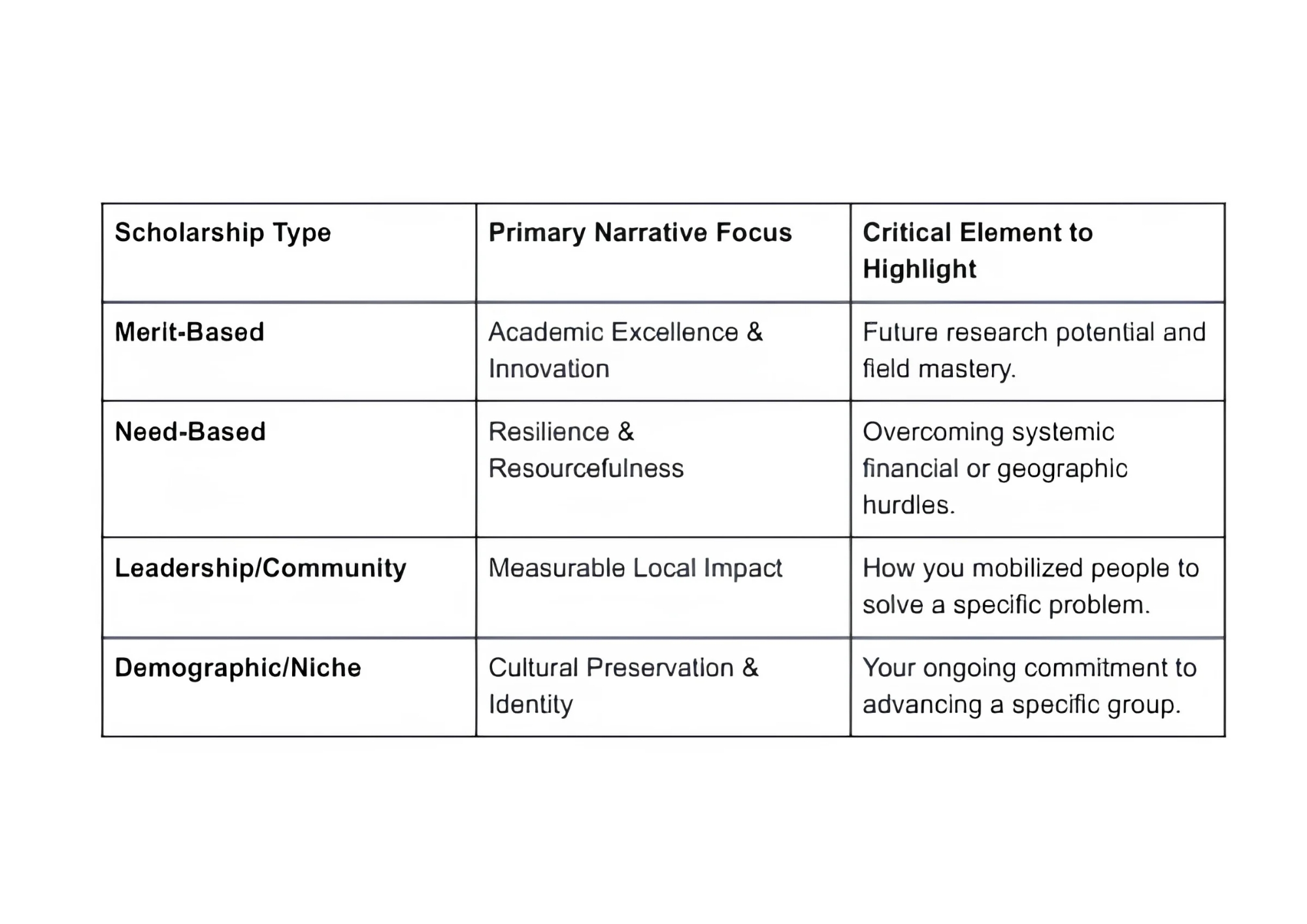
2. Base Your Story on the “Core Mission Matrix”
Every major scholarship has a specific structure. Your essay should be tailored to fit the category you are applying for to meet the evaluation criteria of the board.
Use this matrix to make sure your essay’s tone aligns with the scholarship’s values:
3. Grab the Reader in the First Three Sentences
Scholarship committees read hundreds of essays daily. If your essay starts with something like, “My name is Alex and I want to study engineering because it’s my passion,” it will quickly lose the reviewer’s attention.
Start in the middle of a meaningful moment. Begin with a vivid and active situation that connects your story to your field of study.
Example: “Standing over the broken water pump in my village, I realized that my interest in mechanics wasn’t a hobby—it was an infrastructure necessity.” This immediately creates a picture and shows how your field is relevant to real-world problems.
4. Create a Clear Personal Story
A winning essay isn’t just a list of achievements. That’s what your resume is for. Your essay needs to connect your past experiences, current choices, and future goals in a natural way.
The Story Formula: Start with a challenge or observation → Describe the specific steps you took to address it → Reflect on what you learned → Explain how this scholarship is the key to your next step in life.
5. Measure Your Impact
Statements like “I helped a lot of kids learn math” don’t show your real abilities. Scholarship committees want to see real results that prove your effectiveness.
The Data Conversion Strategy: Change all your accomplishments into clear numbers.
Before: “I ran a student club at school.”
After: “As President, I grew the student engineering club from 12 to 45 members and raised $1,500 in sponsorships for our annual hackathon.”
6. Make Your Budget Request Clear
Many scholarship essays fail because the writer doesn’t explain exactly how the money will be used. Be specific and transparent about how the funds will help you.
Be Transparently Precise: Clearly explain how the award money will be used. Whether it covers tuition, funds research equipment, or helps you focus on studies without working, it shows you have good planning skills.
7. Use the “Show, Don’t Tell” Approach
Never just say you have a particular skill. If you’re a leader or good at problem-solving, let your story show it naturally.
Don’t Tell: “I am very resilient and handle stress well.”
Show: “When our main research server crashed just two days before the publication deadline, I organized an alternative database plan that saved 95% of our data.”
8. Avoid the “Tragedy Trap”
While it’s okay to share challenges or personal hardships, especially for need-based scholarships, your essay shouldn’t sound like a desperate plea for help.
Keep the Focus on Your Actions: Dedicate about 25% of the essay to telling the challenge and 75% to explaining what you did, how you overcame it, and where you’re headed.
The committee is investing in your potential, not just your past hardships.
9. Perform a Multi-Stage Editing Process
Grammatical and punctuation errors are easy ways for a committee to reject your application. Treat your editing as a multi-step technical process.
The Read-Aloud Test: Read your essay aloud. If you stumble over a sentence, it’s too long or awkward. Simplify it.
The AI Check Disclaimer: Use tools like Grammarly to find spelling mistakes, but keep your unique voice. Avoid overly formal or stiff language that takes away from the human feel of your writing.
The Double-Blind Review: Have two people read your essay—one who knows your field and one who doesn’t. If the non-expert can’t understand your main purpose, you need to rethink your message.
Conclusion
Learning how to write a winning scholarship essay is a form of smart self-promotion. By moving away from clichés, focusing on measurable achievements, and clearly showing how your story matches the scholarship’s mission, you make your application a strong investment for the committee.
What scholarship essay are you currently working on? Let us know in the comments!


 Saferoamer