
 Saferoamer
Do you know how to negotiate your salary for any abroad job? Well, landing an international job offer is a massive career victory.
However, calculating the actual value of that offer introduces complex variables that go far beyond a simple base salary figure. A salary that allows for a luxury lifestyle in one country might barely cover rent and basic necessities in another due to local taxes, currency fluctuations, and shifting economic conditions.
If you want to know how to negotiate your salary for a job relocation abroad, you must stop focusing solely on the base salary number. You need to view your compensation through the lens of purchasing power and local cost of living while negotiating a robust relocation package to protect your financial transition. Below is an extensive, data-verified blueprint to navigating international compensation discussions this year.
How to Negotiate Your Salary for Job Relocation Abroad
1. Calculate Your Real Purchasing Power (The Local Baseline)
Never convert a foreign salary offer straight back into your home currency to determine if it is a good deal. You must evaluate the offer using the local purchasing power of your destination city.
Research Cost-of-Living Indices: Use independent databases like Numbeo or the Expatistan Cost of Living Index to compare your current city against your target destination.
Factor in the Core Expat Premium: Remember that moving to a new country introduces unique expenses that locals do not face, such as temporary housing, private health insurance, international school tuition, and regular flights back home to visit family.
Analyze Local Tax Frameworks: Research the exact progressive tax brackets of your destination country. A high gross salary can shrink rapidly under the heavier tax structures found across Western Europe compared to the tax-free systems of the Middle East.
2. Decode the Total International Compensation Matrix
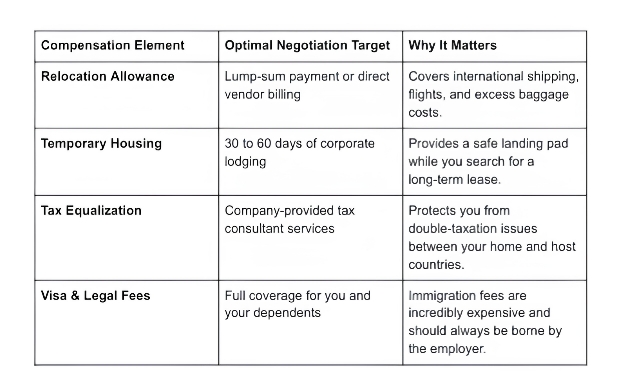
When negotiating an international move, your base salary is only one part of the equation. You must negotiate a comprehensive relocation package to cover the immense upfront costs of moving across borders.
Use this structural reference guide during your negotiation discussions:
3. Leverage the “Cost-of-Living-Adjustment” (COLA) Strategy
When discussing your numbers with global HR teams, avoid making emotional or personal arguments. Instead, base your counteroffer on objective, market-driven economic data.
Frame Around Value, Not Expenses: Do not say, “I need more money because rent in London is expensive.” Instead, say, “Based on current market data for this role in London, combined with the cost-of-living index shift from my origin city, a base salary of [X] ensures my compensation aligns with local market standards.”
Request a Split-Payroll Option if Available: If you are moving to a country with high currency volatility, ask if the company can pay a portion of your salary in a stable currency (like USD or EUR) to protect your savings from inflation.
4. Protect Your Family’s Transition (Dependent Allowances)
If you are relocating with a spouse, partner, or children, your negotiation strategy must expand to include dependent allowances.
Spousal Career Support: Many forward-thinking companies offer career transition stipends to help your partner find employment, secure local work permits, or pursue higher education in the new destination.
Education Allowances: If local public schools require fluency in a language your children do not speak, negotiate for a private international school allowance. International schooling is one of the single biggest out-of-pocket expenses for moving families.
Home Leave Benefits: Negotiate for annual round-trip flight allowances for your entire family to return home once or twice a year.
5. Formalize Everything in the Relocation Agreement
A verbal promise during a video interview holds no legal weight when it comes to international immigration and corporate payroll adjustments.
Review the Written Offer Line-by-Line: Ensure every single negotiated perk—from shipping container sizes to visa processing timelines—is explicitly written out in your formal contract or attached relocation addendum.
Check Clawback Clauses: Pay very close attention to relocation clawback clauses. Most companies require you to pay back a prorated portion of your moving costs if you voluntarily leave the company within your first 12 to 24 months of employment.
Conclusion
Negotiating an international salary requires moving away from local mindset calculations. By looking past the gross base salary number, anchoring your counteroffers in verified cost-of-living metrics, and structurally addressing upfront relocation allowances, you can secure an international move that elevates both your career and your financial trajectory.
Which country’s salary structures are you currently analyzing for your move? Let us hear your thoughts in the comments section!


 Saferoamer