
 Saferoamer
As a graduate, do you know how to write an international resume for global relocation? Then, this blog article is for you.
Applying for a job in your home city is straightforward. You know the local corporate culture, the standard formatting, and what local HR managers expect. However, when you cross borders to target international markets, your standard resume can easily get lost in translation.
Global recruiters handle thousands of applications from different time zones, meaning your formatting choices can either accelerate your application or trigger an automatic rejection. If you are trying to figure out how to write an international resume that stands out, you cannot simply update your contact details and hope for the best. You need to structure your document to navigate automated tracking tools and address global relocation concerns upfront.
Below is an extensive, data-verified blueprint to building a high-impact international CV this year.
How to Write an International Resume for Global Relocation (2026 Guide)
1. Clear Relocation Intent (The “Header” Rule)
The first question an international recruiter might ask when reviewing your resume is: “Is this person allowed to work here, or do they need a visa?” If your current location doesn’t explain why you’re applying from a different country, some recruiters may reject your resume to save time.
You should clearly state your location status right after your name:
Format Example 1 (If you need sponsorship): John Doe | London, UK (Open to Relocation / Requires Visa Sponsorship)
Format Example 2 (If you have dual citizenship or a visa): Jane Smith | New York, US (Valid EU Passport Holder / No Relocation Assistance Required).
By placing this information under your name, you quickly inform the hiring team about your mobility status.
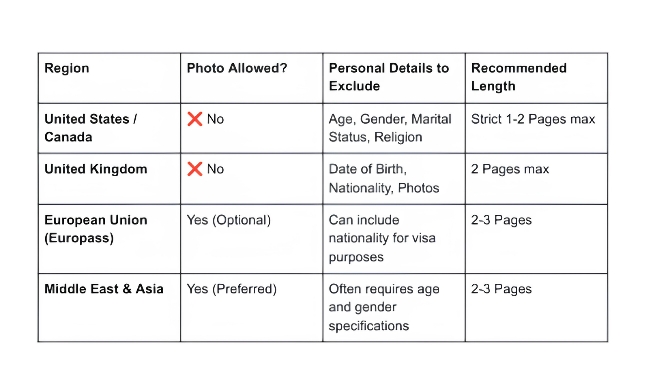
2. Master the Global Format Matrix
Different countries have strict legal regulations regarding what personal details can be included on a CV. Including the wrong information can cause HR software to instantly delete your application to comply with local anti-discrimination laws.
Use this quick regional reference guide before finalizing your layout:
3. Standardize Your Education and Metrics
An international recruiter might not recognize the top university in your home city, nor will they understand your country’s specific grading system. To fix this, you must translate your achievements into universally understood benchmarks.
Translate Grades: Instead of listing a local numeric grade or percentage, use standardized phrasing like “Graduated in the Top 5% of the Class” or “Achieved First-Class Honors equivalent.”
Clarify Company Scale: If you worked for a large local corporation that isn’t globally famous, add a brief context snippet under the company name. Example: “ABC Logistics (The largest third-party supply chain provider in Southeast Asia).”
Universal Currency: When highlighting financial or budgetary success, convert your local currency metrics into US Dollars ($), Euros (€), or British Pounds (£).
4. Pass the International ATS (Applicant Tracking System) Filter
Before a human eye ever sees your international resume, it must pass through an automated scanning tool. These systems scan for specific keyword matching. If your layout is overly complex, the system will misread your data.
Stick to Plain Text Formatting: Avoid complex visual elements like progress bars for skills, custom tables, or background graphics. Use simple markdown headings and bulleted text.
Incorporate Sponsor-Heavy Keywords: Integrate terminology that shows you understand the global marketplace. Use phrases like “cross-functional global teams,” “international regulatory compliance,” or “multilingual vendor management.”
Standard File Naming: Save your file using a crystal-clear, searchable system. Good Example: John-Doe-Senior-Developer-Resume.pdf. Avoid generic names like Resume-Update-2026.pdf.
5. The Professional Summary: Your Relocation Pitch
Replace your old career objective with a strong 3-4 sentence professional summary. This section should act as your elevator pitch, explaining your main skills and why you want to work in the target country.
Example International Summary:
“Results-driven Data Analyst with 6+ years of experience managing large-scale predictive modeling projects for multinational financial firms.
Proven track record of scaling data infrastructure across distributed remote teams. Actively seeking to leverage deep technical expertise within the German tech ecosystem; fully prepared for immediate relocation to Berlin.”
Conclusion
Writing a successful international resume is an exercise in cultural translation. By clarifying your visa status upfront, adhering to regional privacy laws, and translating your metrics into universally understood terms, you remove the hidden frictions that cause global recruiters to pass on overseas talent.
Which country’s job market are you currently formatting your resume for? Let us know in the comments section below!


 Saferoamer