 Saferoamer
Do you know there are online learning platforms for students in 2026? Some of them are free platforms while others are paid platforms. The educational landscape has shifted entirely.
Students face a major dilemma that is the rising cost of traditional degrees versus the need for modern, job-ready skills. Whether you want to ace your university exams, build a creative portfolio, or learn to code from scratch, choosing the right digital classroom is critical. Finding the best online learning platforms for students is the easiest way to bridge this gap without breaking the bank.
Because no single platform fits every learning style, we analyzed the latest student data, forum discussions, and feature updates. Based on verified student feedback, affordability, and certificate value, here are the top choices available this year.
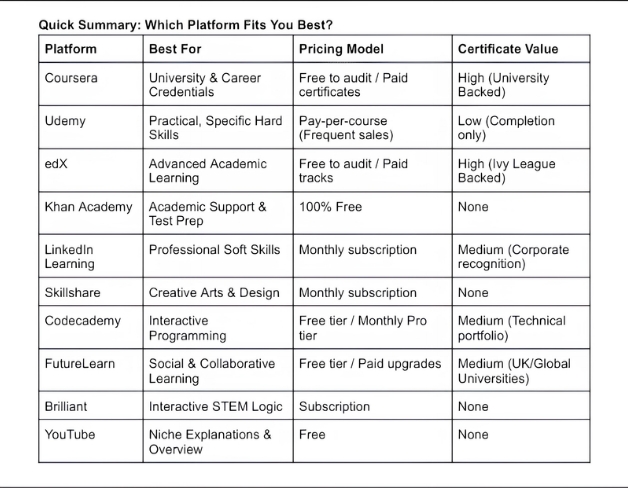
Quick Summary: Which Platform Fits You Best?
Why These are the Best Online Learning Platforms for Students in 2026
1. Coursera
The Student Verdict: Students consistently rate Coursera as a top choice for resume building. By partnering with elite global universities (like Yale) and tech giants (like Google), the certificates carry real weight with employers.
The Budget Hack: You can “Audit” almost any course for free. This gives you full access to reading materials and videos without paying a dime. You only pay if you want to unlock graded assignments and a shareable certificate.
2. Udemy
The Student Verdict: With over 200,000 courses, Udemy is the ultimate marketplace for specific skills like learning a software program, a specific coding language, or video editing. Courses are created by independent instructors, meaning content is updated much faster than traditional textbooks.
The Budget Hack: Never pay full price on Udemy. The platform runs massive sales almost every week, dropping $150 courses down to $10 to $15.
3. edX
The Student Verdict: Founded by Harvard and MIT, edX is designed for students who want rigorous, university-level coursework. It features “MicroMasters” programs that can sometimes count as credit toward a real-world degree.
The Budget Hack: Like Coursera, edX offers a free unverified track. If you want the certificate, look out for seasonal student discount codes that slice up to 15% off the verified price.
4. Khan Academy
The Student Verdict: Khan Academy remains a beloved, non-profit platform that is 100% free forever. It is highly praised by students who are struggling with complex core subjects like calculus, physics, or macroeconomics.
Bonus Feature: It offers official, world-class prep tools for standardized exams like the SAT and LSAT without hiding anything behind a paywall.
5. LinkedIn Learning
The Student Verdict: Formerly Lynda.com, this platform shines for corporate, leadership, and soft skills (like time management or public speaking). Because it links directly to your LinkedIn profile, completing a “Learning Path” automatically updates your resume for recruiters to see.
The Budget Hack: Do not buy this individually first. Hundreds of universities and local public libraries provide students with 100% free premium access using a student ID or library card.
6. Skillshare
The Student Verdict: Skillshare moves away from rigid testing and focuses entirely on project-based learning. It is the community favorite for graphic design, photography, illustration, and creative writing.
The Format: The classes use micro-learning which consists of short, highly engaging videos that fit into busy student schedules. Note that it does not offer formal certificates; your value comes from the portfolio pieces you build.
7. Codecademy
The Student Verdict: Codecademy removes the frustration of setting up complicated coding environments. You code directly inside your web browser with real-time error feedback, making it incredibly beginner-friendly.
The Budget Hack: The free tier gives you access to basic lessons in HTML, CSS, and introductory Python, which is more than enough to see if coding is right for you before upgrading to Pro.
8. FutureLearn
The Student Verdict: Popular among UK and European students, FutureLearn treats education like a conversation. Every lesson has a built-in comment feed where you actively debate and solve problems with international students taking the same course.
The Structure: Courses are split into manageable weekly bites, making it great for students who need external structure to stay disciplined.
9. Brilliant
The Student Verdict: Brilliant completely bans long, boring video lectures. Instead, it teaches math, data science, and physics through interactive puzzles and visual paradoxes. Students who hate traditional lectures find this gamified approach highly addictive and effective.
10. YouTube Learning
The Student Verdict: While not a structured platform, YouTube is the world’s largest educational search engine. When a professor’s lecture doesn’t click, students turn to YouTube to find visual explanations.
Channels to Trust: For structured learning on YouTube, students recommend CrashCourse (for humanities and sciences) and freeCodeCamp (for full-length, ad-free programming bootcamps).
Student Buying Guide on How to Choose the Best Online Learning Platforms for Students in 2026
To avoid wasting time or money, ask yourself these three questions before signing up:
1. Do I need a resume boost? If yes, stick to Coursera or edX. Employers value their university partnerships.
2. Do I just need to learn a specific tool? If you just need to learn Excel or Photoshop for a class project, buy a highly rated, cheap course on Udemy.
3. Am I broke? Start with Khan Academy or see if your university email gives you free access to LinkedIn Learning.
Conclusion
There is no single “perfect” online learning platform in 2026. The best choice depends entirely on your immediate academic or career goals. Take advantage of free trials and audit modes before spending any money.
What skill or subject are you planning to master this semester?


 Saferoamer