
 Saferoamer
Most fresh graduates leave the university feeling bothered about getting jobs abroad after graduation. Finishing your university degree is a significant accomplishment.
However, entering the job market can be challenging, especially if you are looking forward to getting jobs abroad after graduation. Most entry-level job postings require 2 to 3 years of work experience, and it’s uncommon for companies to offer corporate visa sponsorship for recent graduates. If you’re seeking jobs abroad after graduation, the key is to avoid standard job boards.
It is more recommended to use specialized international visa tracks that are designed for recent graduates. Fresh academic talent is valued by governments and multinational corporations, who have established organized channels to draw in young professionals.
Below is a detailed, data-supported guide for recent graduates looking to build their careers internationally this year.
The Post-Graduation International Internship Route
Many new graduates make the mistake of immediately searching for permanent corporate jobs. A more effective way to enter an overseas market is through a structured international internship. Many countries offer temporary training visas that allow you to work for up to a year, which can often lead to permanent employment with a company.
1) AIESEC (Global Talent Program): This large, youth-led organization collaborates with companies worldwide to place recent graduates in paid international internships lasting between 3 to 12 months.
2) The Mountbatten Program: A highly respected track that places graduates in business, finance, and marketing roles in New York City or London. They also handle all visa arrangements on your behalf.
3) Bunac / IntraEx: These are specialized visa sponsorship agencies that assist recent graduates in obtaining legal work authorization for short-term professional positions in countries like the US and UK.
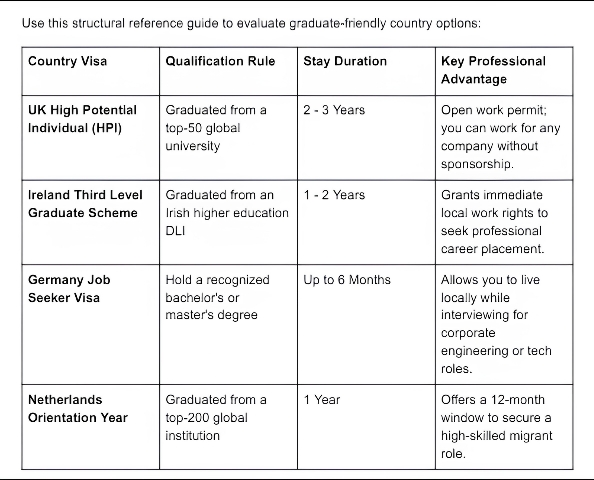
Leverage Direct “Graduate Visa” Frameworks
Several forward-thinking economies have created flexible, independent visas aimed at recent graduates who have completed higher education.
Apply to Multinational Graduate Schemes
Major international companies, such as Unilever, Deloitte, HSBC, and Siemens, run extensive global recruitment programs known as Graduate Schemes or Rotational Leadership Programs.
How They Work: These firms recruit groups of high-potential university graduates and rotate them across different departments over a period of 18 to 24 months.
The Sponsorship Advantage: Because these multinational companies have substantial immigration budgets and dedicated global mobility teams, they are much more likely to sponsor international graduates than smaller local firms.
Important Timeline: These programs often open for applications well in advance—sometimes up to a year before graduation. If you’re graduating in June, you should be applying by September or October of the previous year.
The TEFL and Cultural Exchange Foundation
If you’re aiming for a smoother transition abroad while you figure out your long-term career path, cultural exchange and language teaching opportunities provide quick visa approvals, free housing options, and reliable stipends.
The JET Program (Japan): Managed by the Japanese government, this program places recent university graduates in schools as assistant language teachers. You don’t need a teaching degree, just a bachelor’s degree in any field.
EPIK (South Korea): Similar to Japan’s program, offering flight reimbursements, housing, and a welcoming community upon arrival.
Language Assistants in Spain: Sponsored by the Spanish Ministry of Education, this allows recent graduates to live and work part-time in European schools.
Strategic Optimization: Your Global Graduate Toolkit
To stand out against local candidates who don’t require visa-related documentation, your application materials must be perfectly tailored for international audiences.
Formatting for the Target ATS: Keep your resume entirely in text. Ensure that your graduation dates, degree titles, and major accomplishments are formatted neatly so that automated screening software can easily process your file.
Highlight Global Academic Work: Without corporate experience, focus on your university projects, research, international student exchanges, or leadership roles to demonstrate cross-cultural skills.
Secure Academic References Early: International background check agencies thoroughly review references. Obtain official letters from your professors before your university email access expires.
Conclusion
Finding work abroad after graduation is entirely achievable if you shift your approach towards dedicated graduate pathways.
By aligning your application with global corporate graduate programs, using country-specific orientation visa options, or building your career momentum through international internships, you can overcome the traditional “experience barrier” and start your global career.
Which country’s graduate job market are you planning to enter? Share your target destination in the comments section below!


 Saferoamer